Navigating the 2026 SEO Landscape: How Google’s Algorithm Updates and AI Overviews Impact Local Businesses
The digital landscape has experienced a seismic shift over the past two years. For local business owners who have historically relied on consistent organic search traffic to generate leads and sales, the recent changes to Google’s search engine have been both confusing and, in many cases, detrimental. A "perfect storm" of algorithm updates, the introduction of AI-powered search features, and an increasingly competitive online environment has fundamentally altered how consumers find information and services online.
This article explores the critical changes that have reshaped search engine optimization (SEO) from 2024 to 2026, the profound impact of Google's AI Overviews on website traffic, and why demonstrating Experience, Expertise, Authoritativeness, and Trustworthiness (E-E-A-T) is no longer optional for local businesses—it is essential for survival.
The Perfect Storm: Why Your Organic Traffic May Be Declining
Many business owners have noticed a significant drop in organic traffic starting in late 2024 and continuing throughout 2025. This decline is rarely due to a single technical error; rather, it is the result of three powerful forces converging to reshape the search engine landscape.
1. Google’s Algorithm Updates: The Helpful Content Revolution
Throughout 2024 and 2025, Google released a series of major "core" updates that fundamentally changed how its ranking systems evaluate websites . The most significant of these changes was the full integration of the Helpful Content System into the core ranking algorithm in March 2024 .
This system was explicitly designed to reward content created for people, rather than content created solely to manipulate search engine rankings. It prioritizes websites that demonstrate strong E-E-A-T signals. Consequently, websites relying on generic, thin, or unhelpful content have seen significant drops in their search visibility. The subsequent core updates in late 2024 and throughout 2025 continued this trend, causing significant volatility and disproportionately impacting informational sites that lack deep, demonstrated expertise.
2. The Rise of AI Overviews and Zero-Click Searches
In May 2024, Google officially launched AI Overviews, a feature that provides direct, AI-generated answers to user queries at the very top of the search results page . This innovation has led to a massive surge in "zero-click searches," a phenomenon where users receive their answer directly from Google without ever needing to click through to a website link .
The impact of AI Overviews on organic traffic cannot be overstated. Recent data indicates that AI Overviews now appear for over 13% of all search queries, a number that has more than doubled since early 2025 . Furthermore, when an AI Overview is present, the click-through rate (CTR) to traditional search results plummets to just 8%, compared to 15% for searches without AI summaries . This trend disproportionately affects informational queries, meaning that potential customers seeking educational content or "how-to" guides may never reach your website, even if you rank highly in the traditional results.
3. An Increasingly Competitive Landscape
The online market across various industries is increasingly dominated by large, national providers with massive marketing budgets and exceptionally high domain authority. These competitors possess extensive content libraries, established backlink profiles, and the resources necessary to constantly adapt to Google’s algorithmic changes. For smaller, local businesses, competing for broad, high-volume keywords against these industry giants has become incredibly difficult, if not impossible.
Understanding Google E-E-A-T
To navigate this new reality, local businesses must understand and implement Google's E-E-A-T framework. E-E-A-T stands for Experience, Expertise, Authoritativeness, and Trustworthiness. It is a concept derived from Google’s Search Quality Rater Guidelines and is used by Google’s algorithms to evaluate the quality and reliability of every single search query .
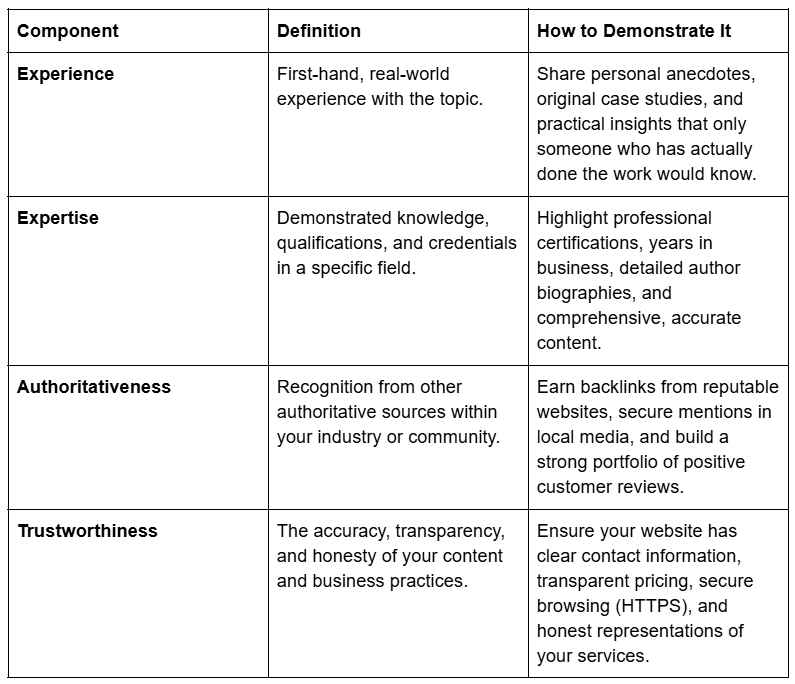
Trustworthiness is considered the most critical component—it is the foundation upon which Experience, Expertise, and Authoritativeness are built. If a website lacks trust, the other three pillars cannot compensate for it.
Actionable Recommendations for Local Businesses
The decline in organic traffic resulting from these industry shifts requires a strategic, long-term commitment to creating high-quality, expert-driven content and shoring up technical and local SEO foundations. Here are actionable steps local businesses can take to adapt and thrive.
Elevate Your Content with E-E-A-T Signals
Generic blog posts are no longer sufficient. Your content must demonstrate superior experience and expertise to satisfy Google's elevated quality standards.
Create In-Depth Guides: Develop comprehensive resources that address the specific, nuanced needs of your local audience. Move beyond surface-level information and provide detailed breakdowns of complex topics relevant to your industry.
Showcase Your Team: Create detailed biography pages for your key staff members or instructors. Highlight their years of experience, professional successes, and unique insights into the local market. This directly builds E-E-A-T by proving the human expertise behind your business.
Use Original Imagery and Video: Replace generic stock photos with original pictures and videos of your team, your facility, and your successful clients. This provides authentic proof of your operations and enhances the user experience.
Optimize for Local Search and Long-Tail Keywords
Attempting to outrank national competitors for broad terms is often a losing battle, especially with the rise of AI Overviews intercepting those queries.
Focus on Long-Tail Keywords: Target more specific, question-based keywords that are less likely to be fully answered by a brief AI summary. These queries often indicate a higher intent to purchase or engage locally.
Double Down on Your Google Business Profile: Ensure your profile is fully optimized, regularly updated with new posts and offers, and actively accumulating positive customer reviews. This is crucial for appearing in the Google Map Pack, a vital source of local traffic that bypasses many of the challenges posed by traditional organic search.
Address Technical SEO Weaknesses
Even minor technical issues can negatively impact your search visibility by confusing search engine crawlers.
Consolidate Your Domain: Ensure that your website is only accessible via a single version (either with or without the "www" prefix). Implement a 301 redirect to consolidate your authority and prevent search engines from viewing your site as having duplicate content.
Implement Structured Data: Use schema markup to help search engines better understand the context of your content, your business details, and your customer reviews.
Diversify Your Traffic Sources
Relying solely on Google organic search is increasingly risky. It is essential to explore other marketing channels to build a more resilient online presence.
Explore Alternative Channels: Invest in paid social media advertising targeting your local demographic, build a robust email marketing list to engage with past and potential customers, and establish strategic partnerships with other local businesses.
Conclusion
The SEO landscape has fundamentally changed. The integration of the Helpful Content System, the proliferation of AI Overviews, and the heightened importance of E-E-A-T have created a challenging environment for local businesses. However, by focusing on demonstrating your unique local expertise, creating genuinely helpful content, and adapting your strategies to align with these new realities, you can build a resilient online presence and achieve sustainable growth in the zero-click era.
References
[1] Google Search Central. "Google Search's Core Updates." Google for Developers.
[4] Kellogg Insight. "As AI Eats Web Traffic, Don't Panic—Evolve." December 1, 2025.